
A friend said to me recently, that he wanted to be a peacemaker in a situation that had become tense. However, as details about the issue in question emerged, he said he didn’t want to be involved.
Why? Because he actually wanted to be a peacekeeper not a peacemaker. There is a big difference.
When discussing it with a good friend, they shared the important distinction between the two, which truly is a game changer regarding which we choose to be.
PEACEKEEPER vs PEACEMAKER
- Peacekeeper: often focuses on keeping things calm, separating sides, and maintain a surface-level status quo or managing tension.
- Peacemaker: Generally refers to someone who actively works to resolve the root cause of a conflict, foster reconciliation, and build lasting agreement where peace did not previously exist.
Most people are “peacekeepers.” They want to avoid conflict and keep things calm. They don’t want to go into the issues because it can create tension.
A peacemaker is one who wants to see conflict resolved and reconciliation happen if possible. This takes work. My friend who said they wanted to be a “peacemaker” proved what they meant was they wanted to be a “peacekeeper.” They didn’t want to get to the root of the problem. They just wanted the problem to go away.
But the Bible doesn’t encourage us to be peaceKEEPERS. It does exhort us to be peaceMAKERS:
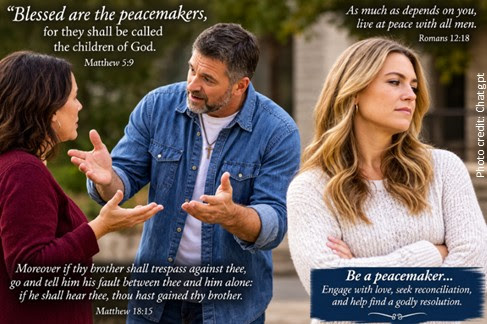
Blessed are the peacemakers, for they shall be called sons of God. (Matt 5:9)
It also encourages us to live peaceable with all — if possible. Which means, it’s not always possible.
If possible, so far as it depends on you, live peaceably with all. (Romans 12:18)
So let me ask you. Are you a peacekeeper or a peacemaker? Are you willing to step into a hard situation to help remove the root of contention? Or do you simply want to turn your head in order to avoid conflict?
The Body of Christ struggles, in my opinion, with conflict resolution. But the Bible gives us the template for how to resolve conflict, remove the root and bring peace into a situation when possible. It is found in Matthew 18: 15-17:
“If your brother or sister sins, go and point out their fault, just between the two of you. If they listen to you, you have won them over. But if they will not listen, take one or two others along, so that ‘every matter may be established by the testimony of two or three witnesses. If they still refuse to listen, tell it to the church; and if they refuse to listen even to the church, treat them as you would a pagan or a tax collector.
May we all take hold of this instruction to live in peace with all men as much as it depends on us, but also, to be willing to embrace biblical conflict resolution and uproot the things that steal peace in a situation. It is only as we remove toxic roots that we can really see peace restore and thrive.
Will you commit to being a peacemaker?
Father,
We come before You in the name of Jesus, asking You to make us true peacemakers in a world filled with division, offense, misunderstanding, and contention. Help us to work for peace in situations for in doing so, Your Word says we are blessed and called the children of God.
Father, we want to reflect Your character in every area including our homes, churches, the workplace, our communities, and our nation. Teach us what it truly means to be peacemakers—not simply people who avoid conflict, keep silent to preserve appearances, or walk away because a situation has become uncomfortable. Strengthen us to be people who are willing to do the hard work of pursuing reconciliation according to Your truth.
Lord, forgive us for the times we have mistaken the absence of conflict for the presence of peace. Forgive us when we have avoided difficult conversations because we feared rejection, confrontation, or the possibility that someone might misunderstand our intentions. Forgive us when pride has kept us from reaching out, or when offense has hardened our hearts. When we have allowed assumptions to replace honest communication, or when we have spoken about someone instead of going directly to that person!
Father, give us the courage to follow biblical conflict resolution and help us resist the temptation to gossip, recruit others to our side, or allow disagreements to grow into divisions that damage relationships and weaken the unity of Your people. Give us humility to speak the truth in love, ears to listen before responding. Give us hearts willing to understand perspectives different from our own.
Holy Spirit, search our hearts and reveal anything within us that is contributing to the conflict. Search me, O God, and know my heart: try me, and know my thoughts: And see if there be any wicked way in me, and lead me in the way everlasting.
Lord, let us never become so convinced of our own righteousness that we cannot hear the correction of the Holy Spirit. Give us discernment to recognize when You are calling us to take the first step toward reconciliation, even when we believe the other person should take the initiative. Remind us that humility is not weakness, repentance is not defeat, and asking forgiveness does not diminish our dignity. Rather, these are marks of a heart being transformed into the image of Christ.
Help us, when possible, to live peaceably with all men. Father, help us understand the wisdom in these words. You call us to do our part, to pursue peace sincerely, and to take responsibility for our own attitudes and actions. Yet You also acknowledge that peace is not always possible, because reconciliation requires more than one willing heart.
Teach us the difference between a relationship in which You are calling us to persevere and one in which we have faithfully done what we can and must release the outcome to You.
Holy Spirit, give us discernment to recognize the difference between avoiding conflict out of fear and stepping away from conflict out of wisdom. Show us when we are using the excuse of peace to avoid a necessary conversation, and when we are using the pursuit of reconciliation to justify remaining in a destructive, manipulative, or continually contentious situation.
Help us recognize when another conversation may open the door to healing and when the same conversations have become a repeated cycle of accusation, denial, manipulation, and strife. We ask for wisdom in knowing when to speak and when to be silent, when to pursue and when to release, when to stand firm in truth and when to lay down our personal preferences for the sake of peace.
We choose today to be peacemakers—not peacekeepers at the expense of truth, not conflict avoiders driven by fear, and not contenders who must win every argument, but faithful servants who seek Your righteousness, reflect Your character, and follow the leading of Your Spirit.
Matt 5:9, Psalm 139:23–24, Rom 12:18
Standing together on our knees,
Karen Hardin